Compression Spring · Sep 02, 2025What is a Compression Spring? Applications, Benefits & Buying Guide
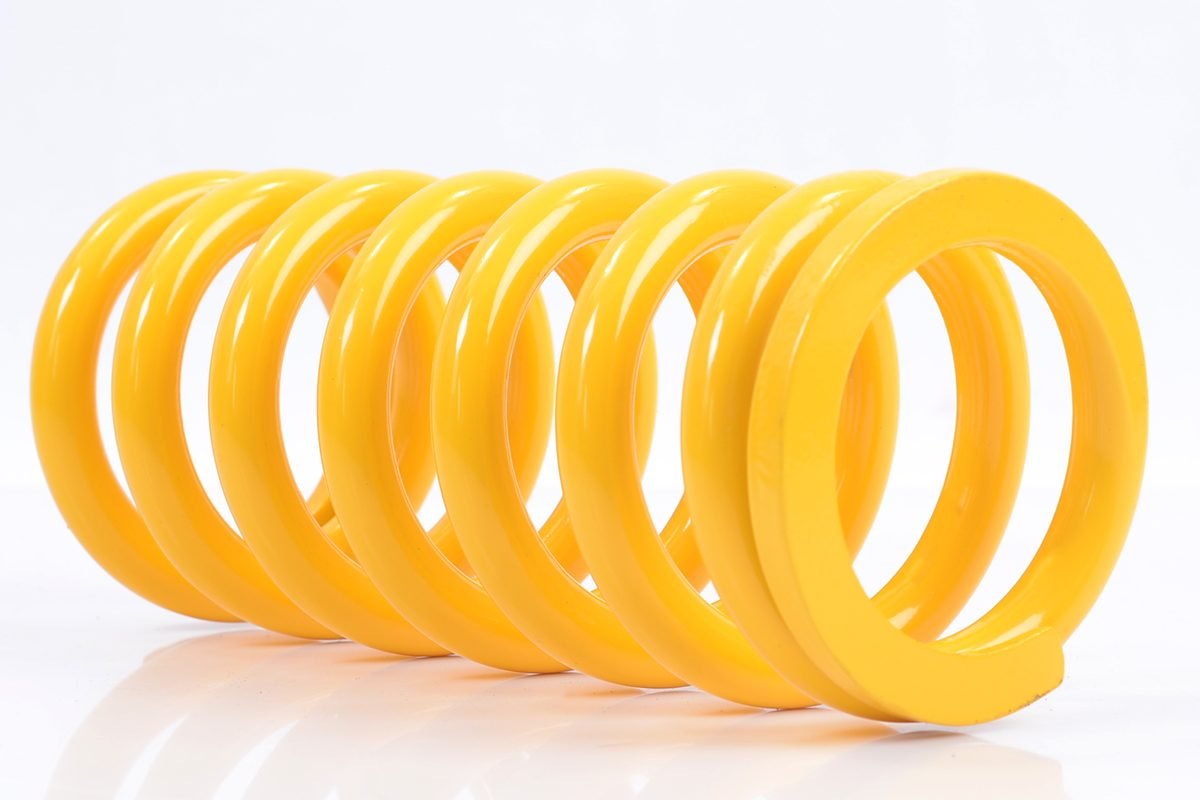
A compression spring is an open-coil helical spring designed to resist a compressive force. When a load pushes on it, the spring shortens and stores energy; when the load is removed, it returns to its original free length. It is the most common spring type in industry.
Where compression springs are used
- Valves, pumps and actuators
- Automotive engines, brakes, clutches and seating
- Switchgear and circuit breakers
- Press tools, fixtures and heavy machinery
- Medical devices, electronics and consumer products
Key parameters to define
| Parameter | What it means |
|---|
| Wire diameter (d) | Thickness of the wire — the biggest driver of load capacity. |
| Outer / inner diameter | Defines the space the spring fits in (bore) or over (rod). |
| Free length | Length with no load applied. |
| Total & active coils | Active coils deflect under load; more active coils = softer spring. |
| Spring rate | Load required per unit of deflection (N/mm). |
| Solid length | Length when all coils touch — the spring must never be forced beyond this in service. |
| End type | Open, closed, or closed & ground. Ground ends give square seating and stable loading. |
Benefits
Compression springs are simple, economical, available in almost any size, and can be tuned precisely through material, wire size and coil count. Correct heat treatment and shot peening give long fatigue life under repeated loading.
Buying tips
- Specify the working loads at defined lengths rather than only the rate.
- Check that the spring will not buckle — long, slender springs may need a guide rod or bore.
- Choose stainless or coated springs for corrosive or food-contact environments.
- Ask for load test reports and material certificates for critical applications.
Buying Guide · Aug 28, 2025How to Specify a Custom Spring: An RFQ Checklist
The fastest way to get an accurate spring quotation is to send a complete enquiry. Use this checklist when you contact us.
- Drawing or sample — a drawing is ideal; a sample or photo with dimensions also works.
- Spring type — compression, tension, torsion, disc, wire form, etc.
- Dimensions — wire diameter, OD or ID, free length, number of coils, end or hook type, leg lengths for torsion springs.
- Loads — required load at one or two working lengths (or torque at given angles).
- Material — or describe the environment (temperature, corrosion, food contact) and we will recommend one.
- Finish — oiled, painted, powder coated, zinc plated, black oxide, etc.
- Quantity — prototype, one-time or annual requirement.
- Documentation — inspection report, load test report, EN 10204 material certificate, third-party inspection.
- Delivery — required date and delivery location (domestic or export).
Not sure about some of these? Tell us what the spring does and where it fits — our engineers will help work out the rest.
Send Your Enquiry
Industrial Springs Comparison · Aug 15, 2025Compression vs Tension Springs – What’s the Difference?
Compression and tension springs are both helical springs, but they work in opposite directions.
| Compression Spring | Tension (Extension) Spring |
|---|
| Force | Resists being pushed together | Resists being pulled apart |
| Coils | Open, with space between coils | Close-wound, usually with initial tension |
| Ends | Open, closed or ground flat | Hooks, loops or threaded inserts |
| Overload | Stops safely at solid length | Can over-extend; hooks are the highest-stress point |
| Typical uses | Valves, suspensions, press tools, switches | Doors, balancers, levers, farm equipment |
How to choose
If the spring must push parts apart or cushion a load, use a compression spring. If it must pull parts together or return a lever, use a tension spring. Where safety matters and there is space, a compression spring is often preferred because it cannot be over-extended.